The Power of Voice in speech communication
Enrol in this course (two different locations):
residential (in a Castle)
(see
flyer)
or non-residential in Geneva
(see
flyer)
Objectives:
- To identify personal strengths and weaknesses in speech communication.
- To choose the speaking style that enhances credibility and persuasiveness.
- To master the emotional dimensions of speech communication.
- To control one’s nonverbal behaviour (facial expressions, gestures, posture).
Programme:
- The role of verbal, vocal and nonverbal behaviour in speech communication.
- Three main vocal skills: chunking, emphasis, intonation.
- Vocal style in public speaking and in face-to-face interaction.
- Verbal aspects: vocabulary (emotional semantic networks); choice of
argumentation strategy (blends of rational and emotional strategies).
- Nonverbal behaviour (facial expressions, gestures, gaze, posture) and their
strategic usage in speech communication.
- Congruence between verbal content and nonverbal behaviour.
- Oratory: most efficient rhetorical figures in speaking and writing.
Method:
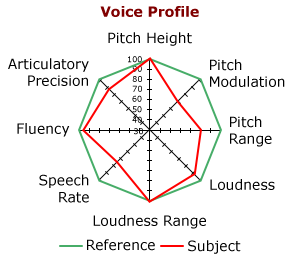
- Acoustic analysis of the participants’ voices: vocal "fingerprint" graph
- Illustration of various models
- Assessment of the impact of voice on audience,
- Practising speaking styles with the help of audio recordings.
The graph below illustrates a voice profile as measured by a computerised acoustic analysis program, where various features of the speaker's voice are compared with a model and presented as % of the reference values.
 Voice Profile